Groq Is Now Native Inside Chatsistant
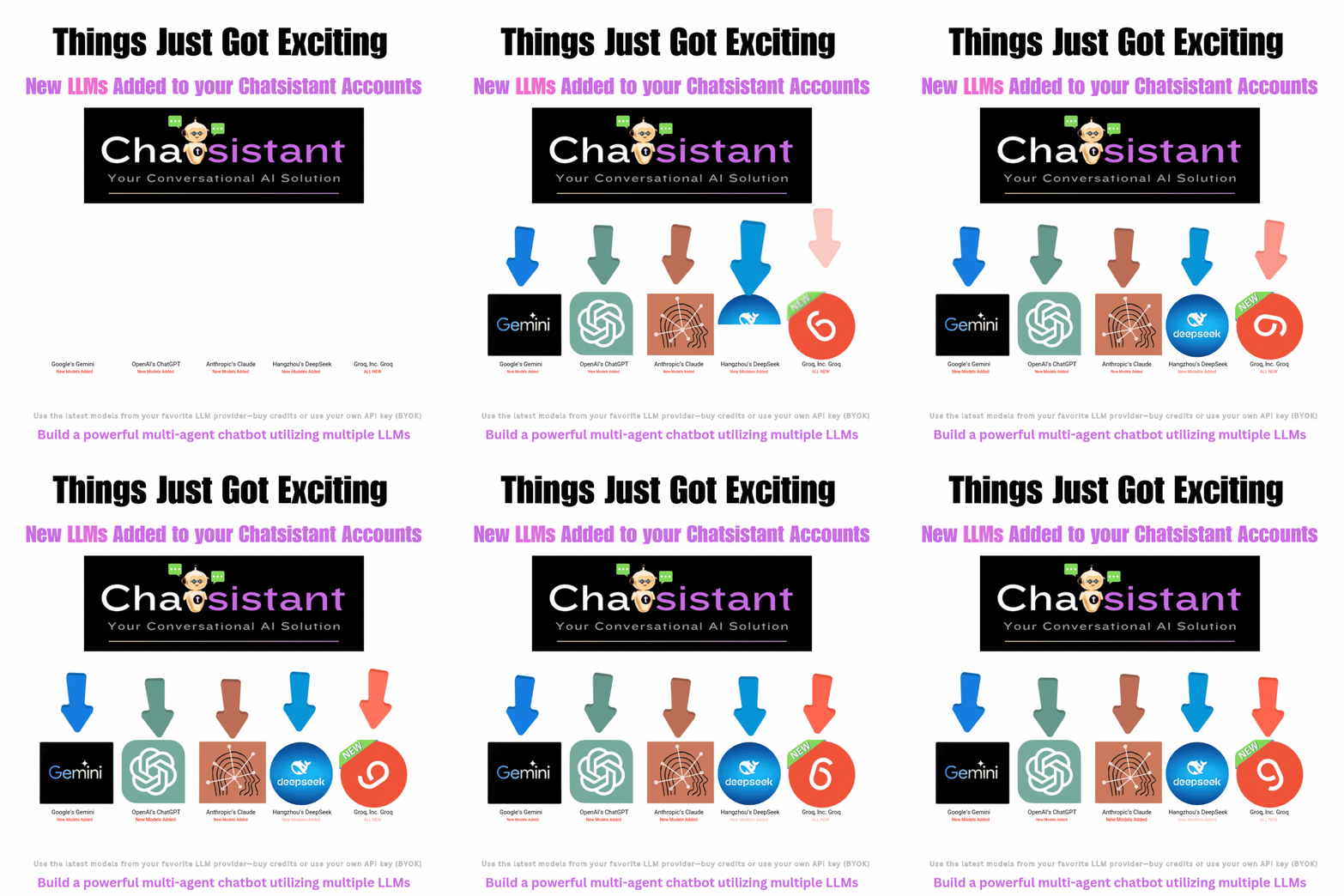
We added Groq as a native high-speed inference provider for supported LLMs inside the Chatsistant framework, giving builders another ultra-fast model path they can assign to individual agents for real-time support, intake, routing, automation, and low-latency workflows.

Why Groq inside Chatsistant matters
Speed matters when AI is handling real conversations, routing users between agents, answering support questions, collecting lead details, or powering automation workflows. Groq is built around high-speed inference, and bringing Groq into Chatsistant gives builders another performance-focused option inside our multi-agent AI framework.
This is not just another name on a list. Chatsistant is designed so different agents can use different model and provider choices depending on the job. That means a chatbot can use one model path for fast front-line responses, another for deeper reasoning, and another for specialized automation or support flows.
Simple version: Groq gives Chatsistant users another fast inference path for real-time agent workflows, customer support, routing, intake, and automation — without forcing every chatbot or every agent to use the same model path.
Quick clarity: Groq is different from an LLM model family
Groq is not a single standalone LLM model family like GPT, Claude, Gemini, DeepSeek, Llama, or Qwen. Groq is best understood as a high-speed AI inference provider. GroqCloud can run supported models on Groq’s fast infrastructure, while the intelligence still depends on the model being used.
That distinction matters. GPT models come from OpenAI. Claude comes from Anthropic. Gemini comes from Google. DeepSeek comes from DeepSeek. Llama models come from Meta. Qwen models come from Alibaba/Qwen. GPT-OSS models come from OpenAI. Groq provides a fast inference path for supported models inside workflows where speed and responsiveness matter.
Also important: Groq is not Grok or xAI. This Chatsistant update refers to Groq, Inc. and GroqCloud-powered inference for supported LLM workflows.
What is new in Chatsistant Platform v1.5.0?
- Groq is now available as a native high-speed inference provider for supported LLM workflows inside the Chatsistant framework.
- Builders can assign Groq-powered model options to individual agents inside their chatbot workflows.
- Groq BYOK support is now available where enabled, giving users another way to connect their own provider key for supported Groq-powered workflows.
- The Chatsistant LLM Hub has been updated to reflect Groq as part of our active provider and model-routing ecosystem.
- The pricing page has been refreshed with clearer model usage guidance, message credit planning, BYOK guidance, and calculator access.
- The mobile inbox experience has been improved with friendlier access to chat details, debug mode, and back-to-inbox controls while reviewing sessions.
Model families, providers, and how Groq fits
The AI ecosystem includes both model creators and infrastructure providers. Chatsistant brings these options together inside a flexible multi-agent framework so builders can choose the right model path, provider route, context size, cost profile, and speed profile for each agent.
Groq’s supported model availability can change over time, but the important idea is simple: Groq helps power fast inference for supported models. Some model families or model paths associated with the Groq ecosystem may include options from Meta, Alibaba/Qwen, OpenAI, and other supported open-model providers depending on current availability.
Llama Models
From Meta. Llama is Meta’s model family. Llama-style options can be useful for open-model workflows, fast chat, routing, and general assistant behavior where supported.
Qwen Models
From Alibaba/Qwen. Qwen models are built by Alibaba Cloud’s Qwen team and can support capable dialogue, technical tasks, reasoning, and automation-friendly workflows where supported.
GPT-OSS Models
From OpenAI. GPT-OSS refers to OpenAI’s open-weight model family, including 120B and 20B paths that can support reasoning, coding, agentic workflows, and developer use cases where supported.
Groq
High-speed inference provider. Groq is the fast provider path, not the model creator for every model it runs. Inside Chatsistant, Groq-powered options are best positioned for low-latency agent workflows.
Model availability, provider pricing, deprecations, naming, and production support can change over time. For current Groq model details, see the official Groq supported models documentation.
Where Groq-powered options are strongest
Groq-powered options are especially useful when speed and responsiveness are a major part of the user experience. That does not mean Groq replaces every deeper reasoning model. It means builders now have another fast path for the parts of a chatbot or workflow where latency matters most.
Fast live chat
Use Groq-powered paths for quick front-line responses, greetings, intake flows, and conversational handoffs.
Intake and routing
Route users faster by collecting details, identifying intent, and handing off to the right agent or workflow.
Support automation
Support teams can use fast model paths for common questions, triage, escalation, and lightweight automation.
Multi-agent handoffs
Use Groq-powered options as part of a broader workflow where some agents optimize for speed and others optimize for deeper reasoning.
Why this is bigger than one provider
Chatsistant is built as a flexible AI framework, not a one-model chatbot tool. That matters because businesses do not all need the same AI behavior. Some workflows need speed. Some need deeper reasoning. Some need large-context retrieval. Some need technical precision. Some need cost-conscious automation at scale.
By adding Groq, Chatsistant gives builders another route for creating faster, more responsive agent workflows while keeping the platform’s broader model-routing strategy intact.
For support teams
Use speed-focused provider paths for fast answers, routing, intake, and customer support experiences.
For agencies
Match model choices and provider paths to each client’s chatbot, budget, workflow needs, and automation strategy.
For builders
Experiment with different LLM providers and inference paths inside multi-agent flows without rebuilding everything from scratch.
For automation workflows
Pair AI agents with webhooks, API access, BYOK provider keys, and future templates for more powerful business systems.
Updated LLM Hub, pricing guidance, and changelog
Alongside the Groq integration, we updated our public LLM Hub and pricing resources so users can better understand which models are available, how provider usage is planned, where BYOK fits, and where to find current platform updates.
Groq BYOK is now available
Groq BYOK support is now available inside Chatsistant where enabled. Users can connect their own Groq API key through the Add AI API Key / BYOK flow and use supported Groq-powered options for fast, low-latency AI workflows.
This gives builders more control over provider usage, cost planning, experimentation, and speed-focused routing while keeping Groq available as part of the broader Chatsistant LLM ecosystem.
Builder note: Groq-powered usage can now be supported through standard Chatsistant message credits or Groq BYOK where enabled. Availability may depend on plan permissions, provider configuration, supported model access, and active account settings.
Mobile inbox improvements and platform polish
This release also includes mobile experience improvements for the Chatsistant inbox and chat session view. We made it easier to access important builder controls while scrolling through a session, including chat details, debug mode visibility, and a cleaner back-to-inbox path.
On the website side, we also introduced a lightweight desktop-only AI particle effect inspired by the Chatsistant brand experience. It is meant to make the site feel more alive and interactive while staying subtle, performance-conscious, and disabled on mobile.
More automation templates are on the roadmap
We are continuing to build toward more partner-friendly automation templates for tools like Make and Zapier. The goal is to help users launch useful workflows faster, connect Chatsistant to the tools they already use, and give agencies or builders a smoother path for client implementation.
This release is another step toward making Chatsistant a more flexible AI operating layer for real businesses — not just a chatbot, but a framework for support, lead generation, automation, routing, and multi-agent workflows.
Explore Groq inside Chatsistant
Groq is now part of the Chatsistant model and provider ecosystem as a high-speed inference path for supported LLM workflows. Explore the updated LLM Hub, review the pricing breakdown, and follow the changelog for BYOK, automation, citation tracking, and platform updates.